Lithium-Ion Batteries vs. Hybrid Supercapacitors
Understand the differences in safety, cycle life, performance, and energy-storage technology.
Lithium-ion batteries and hybrid supercapacitors both store energy, but they differ significantly in chemistry, safety, operating life, and performance. This guide explains how each technology works, and why hybrid supercapacitors can provide a safer, longer-lasting solution for critical power applications.
| Characteristic | Lithium-Ion Battery | Hybrid Supercapacitor |
|---|---|---|
| Energy-storage method | Primarily electrochemical | Electrochemical and electrostatic |
| Cathode material | Lithium metal oxide | Activated carbon |
| Thermal runaway risk | Present | Metal-oxide thermal runaway mechanism eliminated |
| Typical cycle life | 2,000–3,000 cycles at 80% DoD | 20,000–50,000 cycles at 100% DoD |
| Energy efficiency | Varies by battery design | Greater than 97% |
| Discharge capability | Application dependent | Up to 5C |
| Aging concern | Capacity loss and dendrite growth | Substantially longer operating life |
| Best suited for | Higher-energy storage applications | Frequent cycling and critical stationary power |
Specifications may vary based on cell design, manufacturer, operating temperature and application conditions.
Lithium-Ion Battery (LIB)
A lithium-ion (Li-ion) battery stores energy by moving lithium ions between two electrodes: a graphite anode and a metal-oxide cathode. A lithium salt dissolved in an organic solvent serves as the electrolyte.
The metal-oxide cathode is central to the risk of thermal runaway. If the cell overheats or develops an internal short circuit—potentially caused by dendrite growth—the cathode can release oxygen and accelerate a rapid rise in temperature. This self-sustaining reaction can result in fire or explosion.
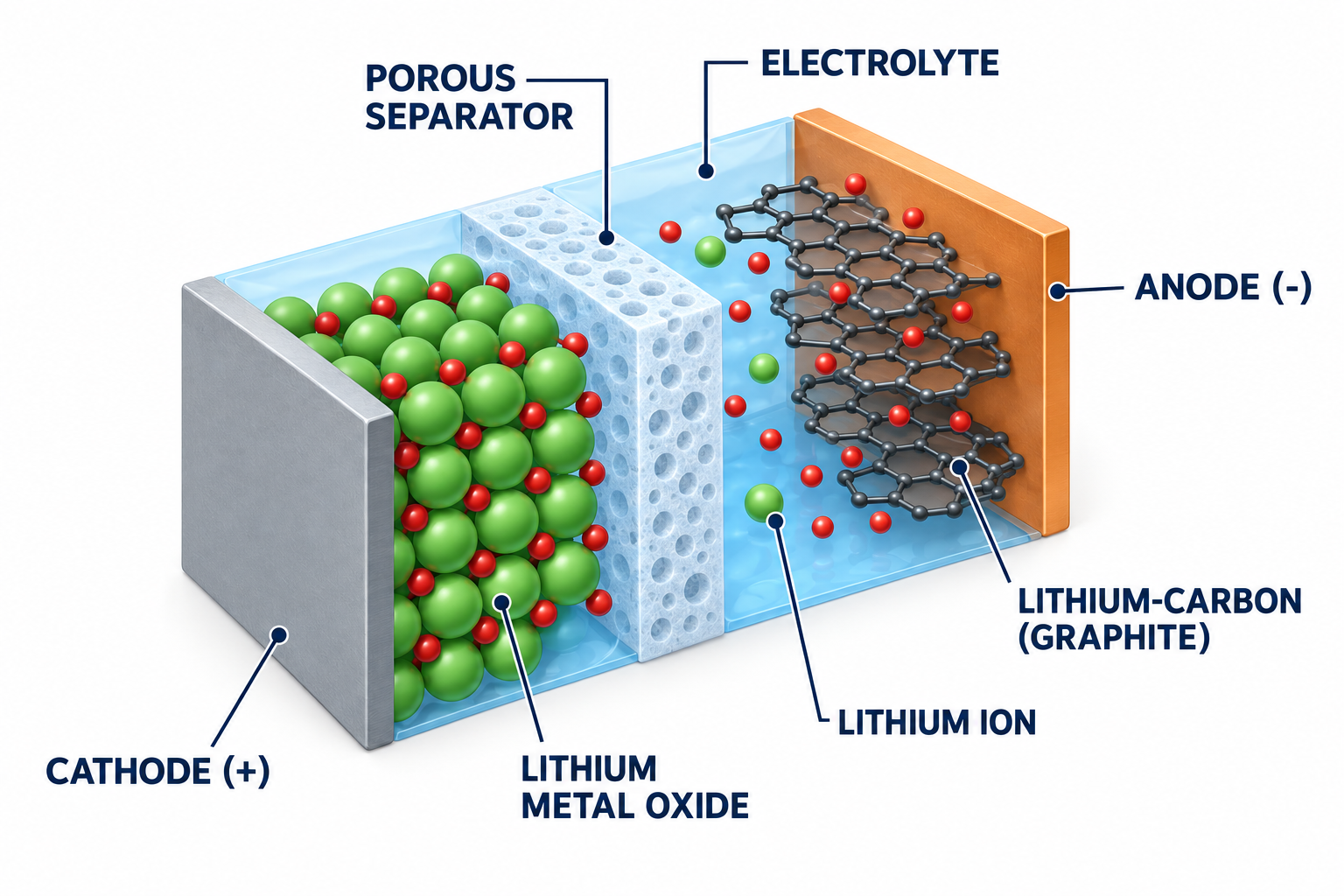
Composition of LIB
Battery Aging and Capacity Loss
Lithium-ion batteries produce energy as lithium ions move between electrodes through a non-aqueous liquid electrolyte. Over time, some ions become permanently trapped in the solid electrolyte interphase (SEI), reducing the number available for energy transfer. This gradual degradation causes capacity loss and typically limits lithium-ion batteries to approximately 2,000–3,000 cycles at 80% depth of discharge.
Capacity Loss
Lithium ions can become trapped in the solid electrolyte interphase, gradually reducing the battery’s available storage capacity.
Dendrite Growth
Metallic structures can form on the anode during charging and potentially penetrate the separator, creating an internal short circuit.
Thermal Runaway
Cell damage or overheating can initiate rapid decomposition, extreme temperatures, fire, or propagation to neighboring cells.
Hybrid Supercapacitors: A Different Approach to Energy Storage
| Traditional Supercapacitor | Li-ion Battery | Hybrid HS Supercapacitor |
|---|---|---|
Advantages
|
Advantages
|
Advantages
|
Limitations
|
Limitations
|
Limitations
No comparative limitations were listed in the source table. |
Performance varies by cell design, manufacturer, temperature and operating conditions. System requirements should determine the appropriate energy-storage solution.
Safety of Hybrid Supercapacitors
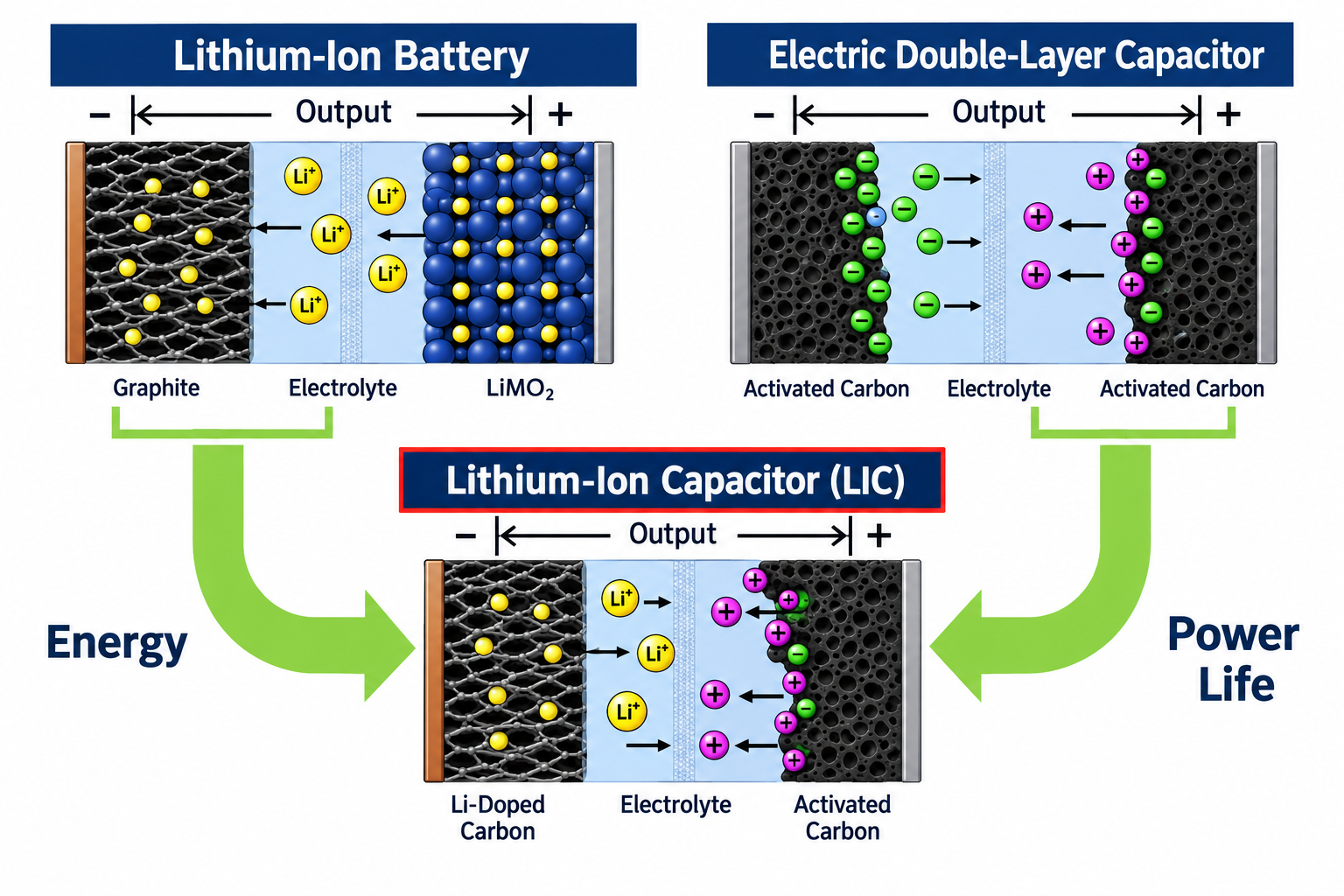
Hybrid supercapacitors use a lithium-doped graphite anode, but their activated-carbon cathode differs significantly from the metal-oxide cathode used in conventional lithium-ion batteries. Because activated carbon does not release oxygen during an internal short circuit, it eliminates the metal-oxide reaction that can drive thermal runaway.
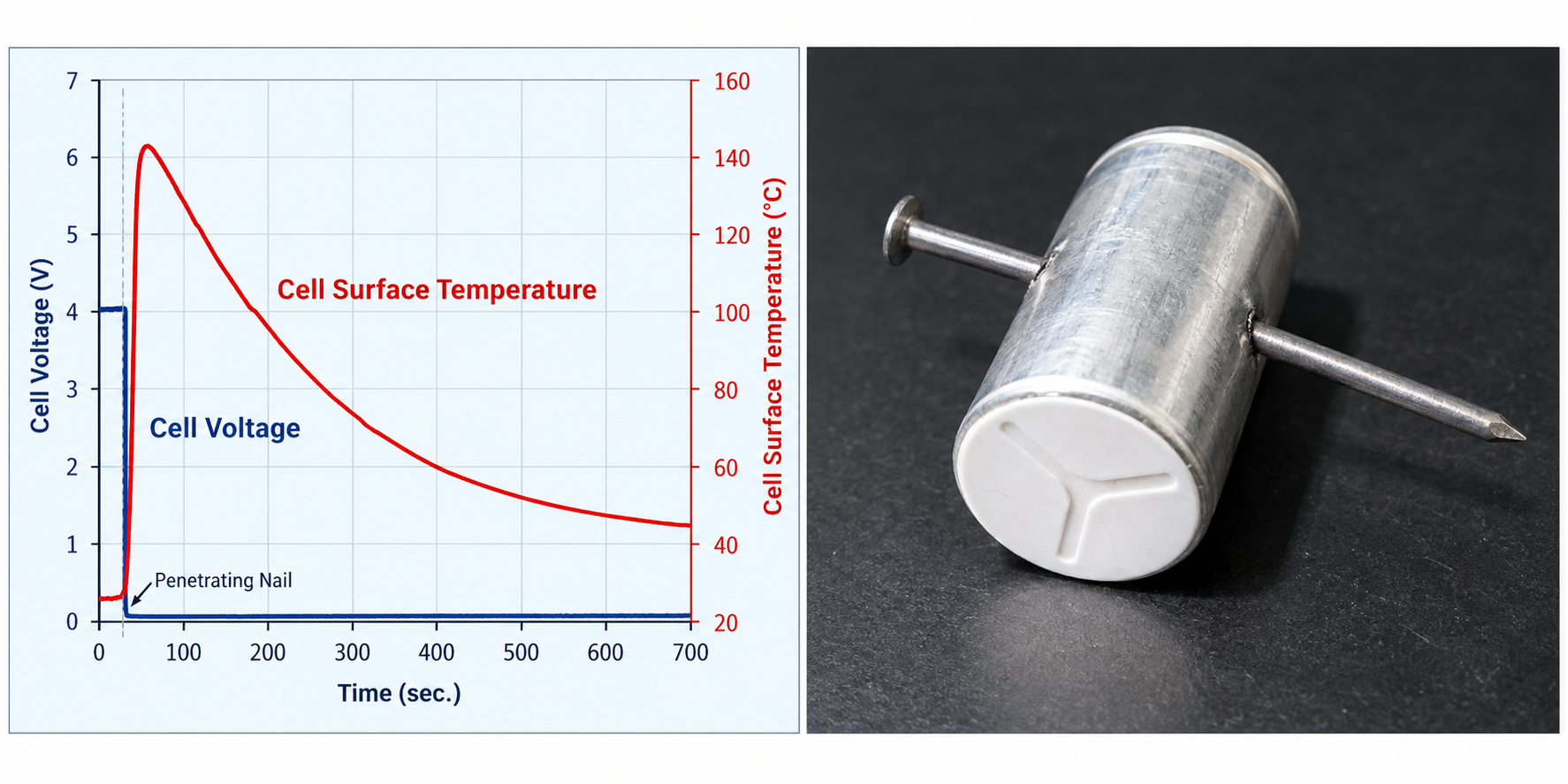
In a cited nail-penetration test of a 200-farad lithium-ion capacitor, the cell’s exterior temperature temporarily reached approximately 100°C before gradually decreasing. The safety valve released internal pressure without thermal runaway, major deformation, fire, or explosion—demonstrating the technology’s improved response to internal short circuits.
Hybrid supercapacitors, also known as lithium-ion capacitors (LICs), combine battery chemistry with the electrostatic energy storage of an electric double-layer capacitor (EDLC) in a single device. This integrated design is not simply a battery and capacitor packaged together—it is a distinct energy-storage technology that balances performance, longevity, and safety.
A hybrid supercapacitor uses a lithium-doped graphite anode and an activated-carbon cathode. Unlike conventional lithium-ion batteries, it does not use a metal-oxide cathode, eliminating the primary mechanism associated with thermal runaway.
This combination delivers greater than 97% energy efficiency, energy density of approximately 120–160 Wh/kg, discharge rates up to 5C, and 20,000–50,000 cycles at 100% depth of discharge and 25°C—making it well suited for frequent cycling and critical stationary power applications.